

 Date: Nov.02.2026
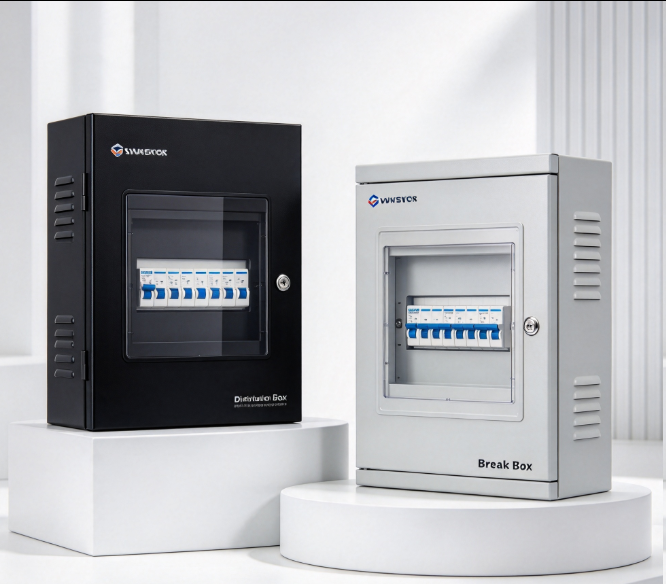
Many people use distribution box and breaker panel interchangeably in daily electrical conversations, yet subtle functional, regional‑naming and structural differences separate these two electrical enclosures. Understanding their distinctions supports correct product selection during building construction, renovation work and equipment replacement projects. In broad definition, a distribution box represents a general‑purpose enclosure category whose core job receives main incoming power then divides electricity into multiple controlled branch circuits. A breaker panel, meanwhile, is one specific subtype of distribution box built around circuit‑breaker protective hardware. Terminology also differs geographically: “breaker panel” dominates North‑American residential vocabulary, while “distribution box” or “distribution board” appears widely across European, Asian, Australian and global IEC‑standard electrical markets.
Breaker panels always integrate circuit‑breaker modules as their central protective element. Inside a typical breaker panel, main service power feeds into a primary main breaker, connected to copper or aluminum bus‑bars, and each individual branch circuit attaches to its own miniature circuit breaker. Every breaker offers automatic overload and short‑circuit protection, cutting power instantly during dangerous electrical events. Most residential breaker panels mount indoors on garage walls, basement surfaces or utility closets, handling 100A‑200A main service capacity for houses. Some compact small breaker panels serve as sub‑panels, receiving power feed from a main panel to distribute electricity for outbuildings, workshop spaces or single building zones.
Distribution box acts as a broader umbrella term covering far more hardware variations beyond breaker‑equipped units. Some distribution boxes hold fuse components instead of modern breakers; industrial‑grade distribution boxes may contain combination of molded‑case circuit breakers, contactors, relay modules and terminal blocks without matching the standard layout of residential breaker panels. Distribution boxes also cover outdoor pole‑mounted, pad‑mounted and weather‑rated enclosure variants built for harsh outdoor environmental exposure, while consumer‑facing breaker panels mostly focus on indoor installation scenarios. Small local distribution boxes may work as secondary power split points downstream of a main breaker panel, delivering power to equipment clusters without connecting directly to utility company incoming service lines.
Practical project selection depends on installation context and protection requirements. If you need central household power input with full short‑circuit and overload safety, a standard breaker panel functions as your main service point. When you require secondary power splitting for workshops, industrial machinery banks or outdoor locations, a general‑specification distribution box can fit better, as it supports flexible combinations of fuses, breakers and terminal hardware. Keep in mind that marketplace product descriptions often blur naming boundaries; always check internal component lists, rated current value and enclosure environmental rating instead of only relying on product titles that swap distribution box and breaker panel labels casually.

 Prev


 Oct.20.2026